Machu Picchu

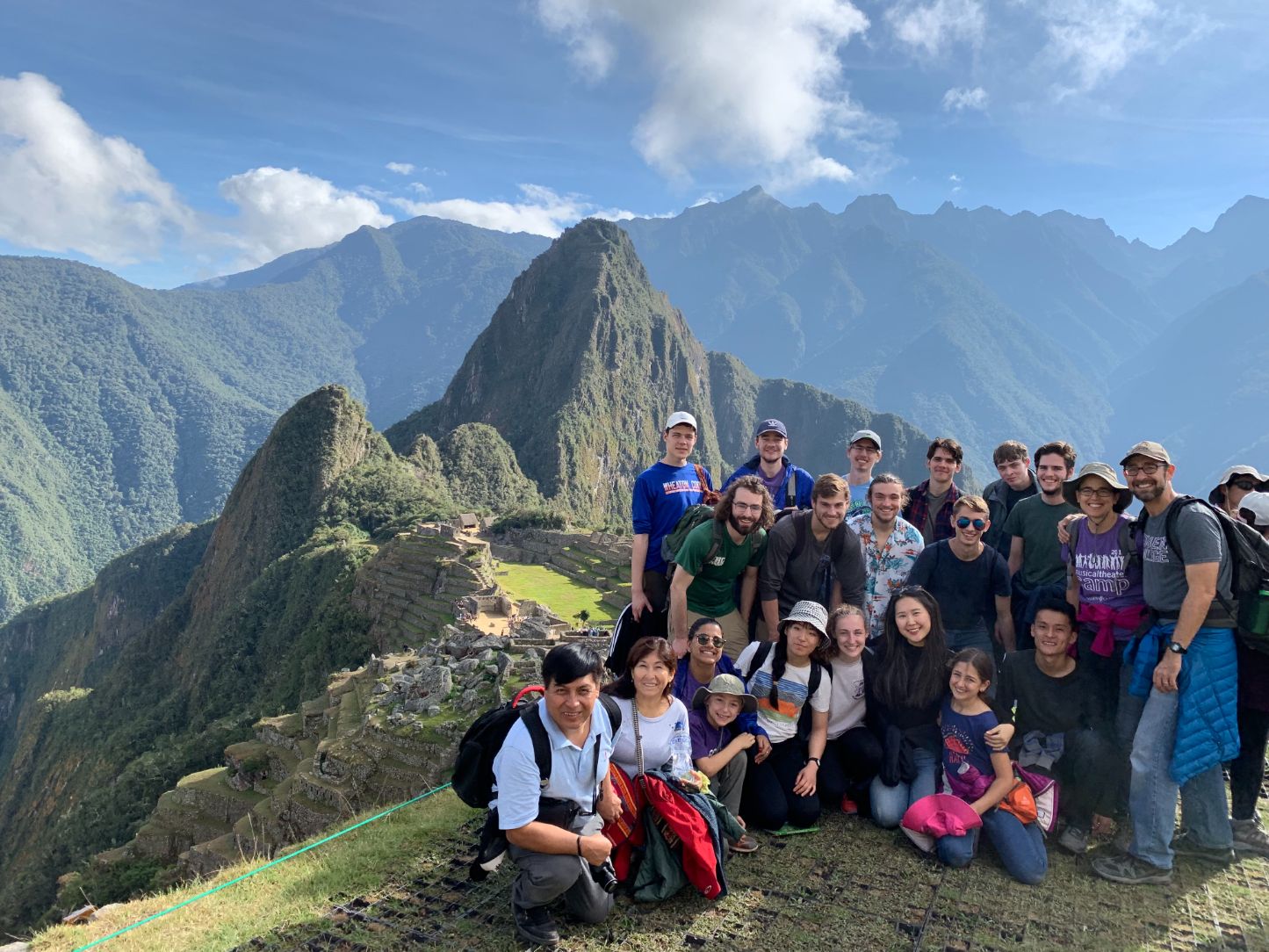
Machu Picchu is one of the “New 7 Wonders of the World,” a list that includes the Great Wall (China), Petra (Jordan), Christ the Redeemer (Brazil), Chichen Itza (Mexico), the Colosseum (Italy) and the Taj Majal (India).

Scholars believe that Machu Picchu (“Old Mountain” in Quechua) was a refuge for the Inca Pachacutec, a sort of “Camp David” perched atop a mountain and surrounded on three sides by water.

We were awestruck by the sight of this magnificent place and the entire group — 21 students, 2 directors and 4 children — hiked to the top of Huayna Picchu (“Young Mountain”) to take in the view from above.


The Incas

The Inca culture is known worldwide for its epic architecture.  Temples, palaces and fortresses were assembled from massive stones cut from nearby quarries and fitted together like a puzzle.  We visited two classic examples:  Sacsayhuaman and Ollantaytambo.

Sacsayhuaman is a huge complex perched on a hill overlooking the city of Cusco, the Inca’s capital.  The main construction is a three-layered wall designed in the shape of a lightning bolt.  Lightning is of mythical importance since it intersects three realms — the heavens (home of the condor), the earth (home of the puma) and the underworld (home of the serpent).

Ollantaytambo is the name of both an ancient city and a fortress that protected its inhabitants.  This is the site of an epic battle between Hernando Pizarro, brother of the famous conquistador Francisco Pizarro, and the indigenous king, Manco Inca.  The Spanish cavalry charged the fortress on horseback but were repelled by amazonian archers, tumbling rocks and clever engineers:  Water channels were diverted to flood the lower part of the fortress and surrounding plain and the Spaniards fled for their lives.


A Changing World

Our theme this semester is, “A Changing World; A Changing Peru”.   In order to appreciate where Peru is going, we need to know where it has been.   If we had a time machine we could travel back to the era before the Spanish Conquest to see how Andean people lived, worked and played before the influences of colonialism and globalization.  Absent such a machine, we ventured higher into the Andes for several days to experience life in a village where ancient traditions are still prevalent.

San Juan de Quihares is three hours from Huacarpay via a seldom-used unpaved road.  Our driver, Hugo, carefully negotiated the windy road, reaching an altitude of 4,200 meters (about 13,800 feet above sea level) before we dropped into a hidden valley on the other side of the pass.  We brought along a typical outdoor lunch — whole potatoes, choclo (corn on the cob), aji (spicy sauce), fresh cheese — and soon finished our journey.

Our guide, Pastor Roberto, helped start a Mennonite Church in this village several years ago.  We unloaded our bags and anxiously awaited the arrival of our hosts.  Ten families agreed to open up their homes to the students and, one-by-one, family members arrived at the church, greeted us and led two or three students back to their homes to spend the next two nights.  This was the first time the families have entertained foreign guests.  They seemed as honored by our presence as we were appreciative for this glimpse at their rapidly-disappearing reality.

The villagers of San Juan de Quihares are mostly subsistence farmers who cultivate crops and herd animals.  These foods are produced naturally — Pastor Zaqueo was proud to tell us that no chemical fertilizers or pesticides have found their way into the valley.  Every three months there is a fair in one of the neighboring villages where people can sell their animals to earn income to buy salt, sugar and other goods that are not produced locally.  The villagers are hard-working and deeply-rooted to the land.  They are reserved around strangers — few outsiders, and no tourists, venture this far out.

When it is time to build a new home, or a kitchen for the Mennonite Church, people rely on materials readily at hand:  earth, straw and water.  We learned how to mix the three ingredients to make adobe bricks (no shoes required).  For thousands of years, Andean people have worked together to build homes, roads, bridges or whatever their community needs in an arrangement called fiena.  A North American might compare this to an Amish barn-raising.  Members of the community converge at a particular time and place, working together to benefit the common good in exchange for companionship and a shared meal.  Our group was blessed to participate in a fiena on the second day of our visit.

On our last day in the village, we visited the local high school.   In contrast to the other schools we have visited in Peru, the curriculum here emphasizes practical, applied learning focused on agricultural production and home economics.  Students come from the surrounding countryside for 15 days at a time, living together in dormitories, then go home for the remainder of each month where they work on research projects of practical value to their families — breeding genetically-superior cuys (guinea pigs), increasing milk production for their dairy cows, promoting healthy and sustainable life-styles that are appropriate to this time and place.

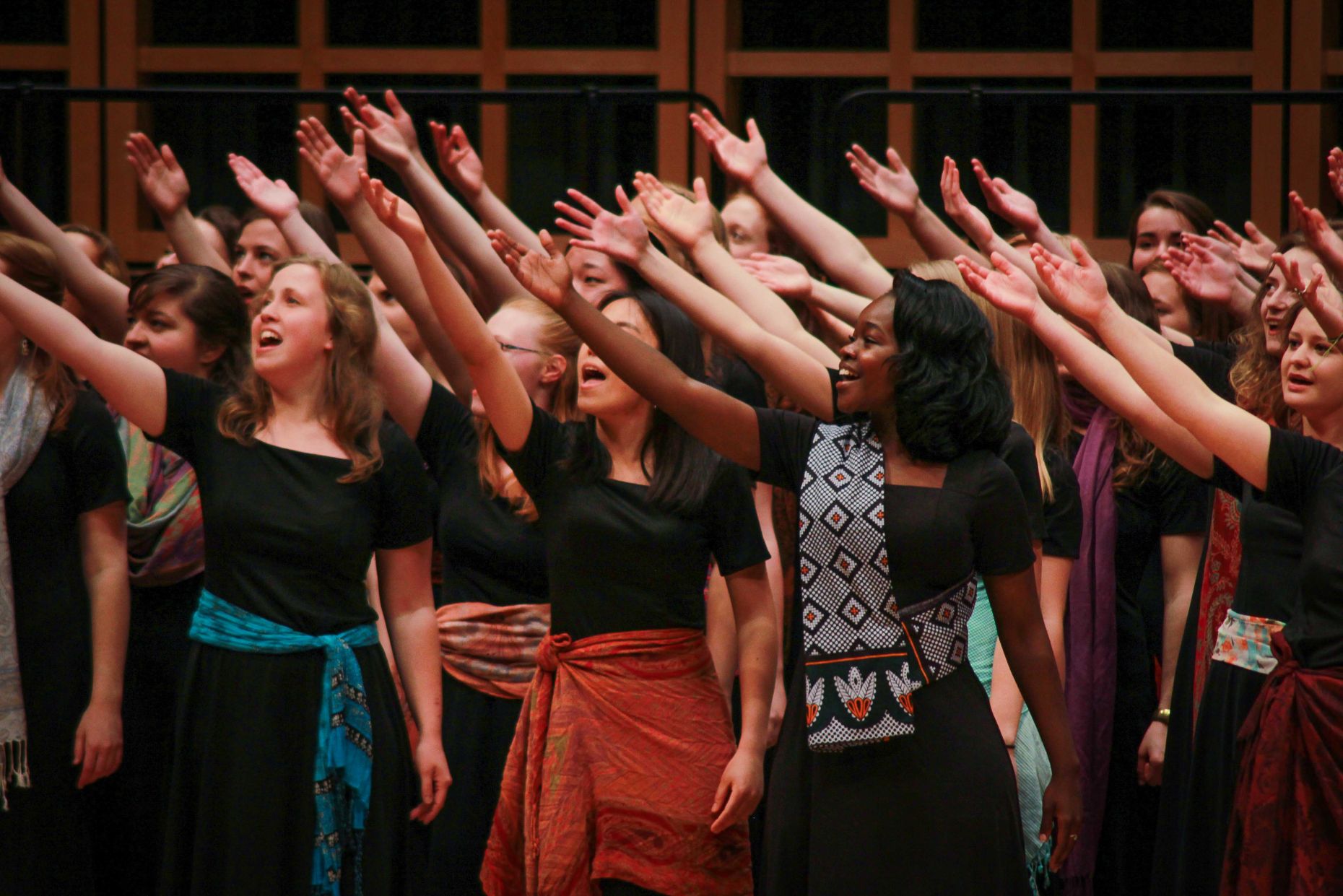
The purpose of our visit to the school was to teach the children about health.  Our students performed several original, humorous and informative skits on dental hygiene and then distributed toothbrushes, toothpaste and fluoride treatment to each child.  Afterward we shared songs from around the world — first our women, then their girls, then our men, then their boys.  We finished with a GC favorite, “606,” a.k.a. Praise God From Whom All Blessings Flow.  Then we said goodbye and boarded the bus.


Andean Culture and Reality

There are many ways to gain understanding of a culture — lectures, workshops, service projects and learning tours.

Juan Carlos returned for a second time to teach us more about Andean spirituality.  Catarina, an agronomy professor at San Antonio Abad National University in Cusco, described the political, social and environmental realities of mining.

Jesica and Herbert demonstrated traditional folk dances from the Cusco region and walked us through the steps.  Some of the traditional beliefs and ethics presented by Juan Carlos and Catarina were embodied in these dances.  To understand their rhythms and cadence we needed to try them ourselves!

We accompanied Pastor Roberto on a service visit to the village of Patabamba, a short drive but a world away from where we have been living.  We spent the morning at the village school where we witnessed firsthand the effects of malnutrition and alcoholism on young children.   We distributed anti-parasite medicine and organized a trash clean-up in the school yard.

Then we grabbed picks and shovels and prepared the soil in a new adobe greenhouse in hopes that the children can supplement their diet with fruits and vegetables.  We transplanted grape, grenadilla, tomato and pepper seedlings.  Afterward we spent some time with one of the teachers who described the politics and reality of Peru’s education system in rural Andean villages.

Pastor Roberto is helping to plant a Mennonite house church in Patabamba and we had lunch in the room where they meet each week.  We learned from the owner how his life has been transformed, leaving a life of alcoholism and offering himself as a positive role model for his family and the community.

After lunch we followed our guide, Juan Hector, on a hike to the archaeological site at Tipon.  Most visitors arrive from below.  We came from above, which was quite an adventure given the condition of the trail.  We learned that the Inca leader Manco Inca Yupanqui used this place to develop irrigation technology.  His father, Pachacutec, relied on military might to expand the empire.  In contrast, Yupanqui focused on maintaining peace through equal distribution of resources.  The fountain that divides the water channel into four equal streams — and is still functioning 500 years later — is a perfect example of Yupanqui’s egalitarian values and Incan ingenuity.


Happy Mother’s Day

Happy Mother’s Day!  Feliz Dia de La Madre!

Mother’s Day is an important holiday in Latin America and the students surprised each host mother with a rose and hand-made card to celebrate the occasion.

Our Peruvian host mothers want to say thank you to all the North American mothers who brought these students into the world, nurtured them into adulthood and graciously sent them here to spend a semester studying and serving others in Peru.

Gracias!